

Radiator and Cooling System Troubleshooting Tips
Radiator and Cooling System
Tips to diagnose car cooling system problem
Issues with the coolant system in your vehicle can be difficult to diagnose. If your vehicle’s engine has been running too hot, overheating or running too cold it could mean there is a leak in the system or one of the components of the system has failed to function. By paying attention to the symptoms your vehicle exhibits and inspecting the coolant system itself, you can often identify the source of the problem fairly easily.
Here are methods for your assistance:
Radiator Troubleshooting tips
Method 1 Car Radiator Repairs
Step 1 – Determining there is a problem
Allow the engine to cool. Your engine bay gets extremely hot while the engine is running, so looking around the engine bay before it has a chance to cool can result in serious burns. Allow the engine to cool for a few hours before opening the hood and looking for evidence of a coolant leak.
If the hood still feels warm, the engine inside is likely very hot.
If your vehicle has been overheating, it will take even longer for it to cool enough to be safe to touch.
Step 2 – Put on the appropriate safety gear
Before starting any automotive project, you should put on the appropriate safety gear. Because you’ll be dealing with coolant that may be leaking, eye protection should be considered mandatory for this project. Gloves are optional but may protect your hands from scratches or bumps as you work.
Always wear eye protection when dealing with coolant leaks, as they may drip or spray under pressure. Glasses or goggles are both acceptable forms of eye protection for this project.
Step 3 – Check the radiator cap for damage
Another common point of failure in coolant systems is the radiator cap. When functioning properly, the radiator cap can release excess pressure that builds up in your coolant system, but over time it can become worn out or stuck. If the radiator cap looks rusty, is corroded, or is caked in grime, it may be the cause of your coolant issues. Replace your radiator cap simply by unscrewing it and screwing in a replacement. Radiator caps are inexpensive and can usually be purchased at your local auto parts store. Never remove the radiator cap from an engine that is still warm. It could spray hot coolant and burn you.
Step 4 – Visually inspect the water pump if you can
If you suspect that your vehicle has a coolant leak, pop the hood when the engine is cool and look at your coolant reservoir. The reservoir will have lines indicating the minimum and maximum coolant capacity for your vehicle. Take note of the level the coolant reaches on the reservoir, then check again in a few days. If it has gone down, the coolant is either leaking or being burned.
Make sure to check each time when the engine is at the same temperature.
If you aren’t sure where your coolant reservoir is consult your vehicle’s owner’s manual.
Method 2 Car Radiator Repairs
Step 1 – Visually inspect your coolant system
Keep an eye on the temperature gauge. The first sign that there is an issue with the cooling system in your vehicle will often come from the temperature gauge. If your vehicle has been running consistently warmer or has recently begun having issues with overheating, there is likely an issue with the cooling system. Also if your heater has stopped working make sure there is no leak in the radiator.
- The temperature gauge in your vehicle should have an acceptable operating range. Even if your vehicle is not overheating but has been running at the higher end of the operating range, there may be an issue.
- If your vehicle is running with the temperature gauge in the red, it is overheating. Pull over and shut off the vehicle.
- Issues with the cooling system can also cause the engine to run cold.
Step 2 – Look for the check engine light
Another early indicator of a problem with your cooling system may be the check engine light on your dashboard. Your check engine light comes on when one of the sensors in your car sends a message to the ECU (Electronic Control Unit) telling it there is an issue. If something isn’t performing properly, the check engine light is how the ECU notifies you.
Many vehicles have dashboard lights that will notify you of low coolant levels or extreme engine temperatures as well.
Step 3 – Identify puddles of coolant below the car
Leaks are a common issue in coolant systems. If you spot a puddle beneath your vehicle, there’s a chance that it may be the result of a coolant leak. Touch the puddle with a finger, then smear it onto a blank white sheet of paper. Oil is often brown or black, water from the air conditioner will be clear, and coolant will likely be green, pink, or orange.
A leak in your coolant system can cause it to fail to maintain proper temperature in the engine.
Step 4 – Check the coolant levels in your vehicle
The water pump in your vehicle pumps the water and coolant mixture through the engine and into the radiator where airflow helps to dissipate the heat. Look for signs that your water pump is leaking or has failed if it is visible in your engine bay. The water pump is belt driven, so inspect the belt for damage that indicates that the water pump pulley has stopped moving and has been rubbing against the belt.
Without a properly functioning water pump, your engine will not be able to dissipate the heat it produces as it runs, causing the vehicle to overheat.
If the belt powering the water pump is damaged, it will have to be replaced after you put in a new water pump.
If you are unsure of where to locate the water pump in your vehicle, refer to its service manual.
Step 5 – Assess damage to your coolant hoses
Look at the hoses traveling from the radiator and to the engine, then follow them along as far as you can. If any of the hoses are kinked, that will cause the coolant system to fail to function properly. Cracks may also indicate a leak, but even if it isn’t leaking yet, a cracked coolant hose should be replaced before it begins to leak. Keep an eye out for damage to the hoses or signs of rubbing from the serpentine or accessory belts.
If one of the belts has been rubbing on a coolant line, they will both likely need to be replaced. Make sure to install the new ones with enough clearance to avoid rubbing the belt on the hose. Leaks in your coolant can result in puddles beneath your vehicle and overheating.
Replace radiator hoses that are leaking or are otherwise damaged.
Method 3 Car Radiator Repairs
Step 1 – Determine how long it’s been since the coolant has been flushed
If there is no sign of a coolant leak and your vehicle is failing to properly manage temperature, it may be a result of your coolant going bad. Drain and flush your coolant by opening the petcock on the bottom of the radiator and draining it into a container, then filling the coolant system with water and running the engine for a few minutes again. Repeat this process a few times to clean all of the old coolant out, then refill it with a 50/50 mixture of water and coolant.
Most coolant comes pre-mixed, but you can purchase only coolant and mix it with water yourself.
Coolant can be purchased at auto parts stores, petrol stations, and large retail stores.
Step 2 – Look for signs of a bad head gasket
If you notice coolant leaking from the engine beneath the exhaust manifold and white smoke coming from your exhaust, your vehicle’s head gasket is probably blown. A blown head gasket will result in coolant leaks, engine overheating, and severe loss of power.
A blown head gasket requires taking the cylinder head off of the engine to repair, so it may be best left to professionals.
If you believe the head gasket in your vehicle has blown stop driving it immediately.
Step 3 – Determine if your thermostat is functioning properly
Your vehicle’s thermostat determines the functioning temperature of your engine. If the thermostat fails in the open position, the coolant will flow continuously through the radiator and the engine will run cold. If it breaks closed, the coolant will not be able to reach the radiator, resulting in overheating. Look for signs of leaking or oxidization around your thermostat to determine if it is causing the issue.
If the thermostat is rusted, it will probably not be able to function properly.
A leak coming from the area around the thermostat would cause it to fail to function.
Step 4 – Look for coolant leaks
If your coolant system is leaking, it will not be able to properly cool the engine and may even result in overheating. When visually inspecting the coolant system, be sure to look for signs of spraying or leaking coolant coming from the radiator as well as the hoses and pump. Follow any coolant you see in your engine bay up to its highest point to identify the source of the leak.
You may want to spray the engine with a hose to remove all the old coolant, then start the engine again to identify where the new coolant leaks out.
If the leak is in your radiator, it will either need to be repaired or replaced by a professional.
Step 5 – Use a pressure tester to locate hard-to-find leaks
Another tool to identify issues with your coolant system is a pressure tester. Remove the radiator cap from your engine and attach the pressure tester in its place. Turn on the heater in your vehicle without starting the engine to allow the coolant system to develop pressure. Watch the gauge on the pressure tester for sudden drops in pressure. A drop in pressure indicates a leak. Then listen in your coolant system for the sound of air escaping to locate the leak.
Your coolant system will need to be drained to properly utilize a pressure tester.


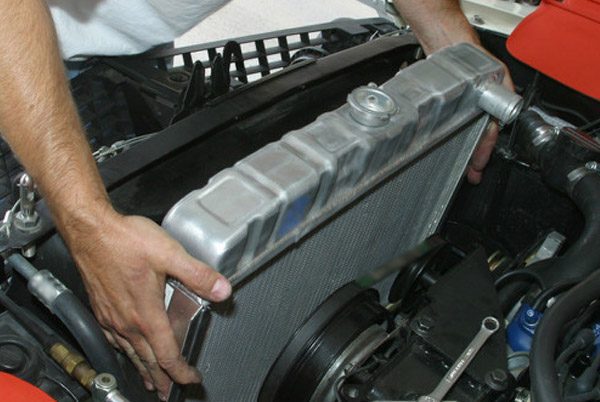
Car Radiator Replacement

We recommend should you be in doubt about how to change or suspect any issues with your radiator or cooling system you take it to an e-CAR workshop near you https://www.e-car.co.za/find-e-car-workshop/

Schedule Your Car Radiator Repair Appointment Today
Don’t let a faulty Radiator or coolant leak make your drive unreliable. Schedule your car Radiator repair with e-CAR and experience the difference professional service makes.
find a workshop near you
e-CAR Services
Car servicing
Routine, minor and major services to keep your vehicle properly maintained.
Car repairs
Full list of repair services
Aircon Regas
Restore your vehicle’s cooling performance with a professional aircon inspection and regas.
Mechanical Repairs
Professional repairs for worn, damaged or faulty mechanical components.
Brake Repairs
Inspection, maintenance and repair of brake pads, discs, fluid and related braking components.
Engine & Cooling
Diagnosis and repair of engine, radiator, water-pump, overheating and cooling-system problems.
Suspension Repairs
Repairs to shocks, wheel bearings, CV joints, and other suspension parts.
Transmission and Clutch Repairs
Diagnosis and repair of clutch, gearbox, transmission and drivetrain problems.
Diagnostics
Advanced diagnostic testing to identify warning lights, electronic faults, engine problems and performance issues.
Commercial-Vehicle Services
Servicing, maintenance and mechanical repairs for bakkies, LDVs and selected commercial vehicles.
Fleet Maintenance
Service a fleet of cars or trucks with a fast turnaround time.
e‑CAR workshops provide a broad range of servicing, maintenance, diagnostic and mechanical repair solutions. Services and vehicle capabilities vary by workshop, so check your local workshop’s profile before booking.
e-CAR Services
Car service
Car repairs
Full list of repair services
Aircon Regas
Restore your vehicle’s cooling performance with a professional aircon inspection and regas.
Mechanical Repairs
Professional repairs for worn, damaged or faulty mechanical components.
Brake Repairs
Inspection, maintenance and repair of brake pads, discs, fluid and related braking components.
Engine Cooling
Diagnosis and repair of engine, radiator, water-pump, overheating and cooling-system problems.
Suspension Repairs
Repairs to shocks, wheel bearings, CV joints, and other suspension parts.
Transmission & Clutch Repairs
Diagnosis and repair of clutch, gearbox, transmission and drivetrain problems.
Diagnostics
Advanced diagnostic testing to identify warning lights, electronic faults, engine problems and performance issues.
Commercial-Vehicle Services
Servicing, maintenance and mechanical repairs for bakkies, LDVs and selected commercial vehicles.
Fleet Maintenance
Service a fleet of cars or trucks with a fast turnaround time.
e‑CAR workshops provide a broad range of servicing, maintenance, diagnostic and mechanical repair solutions. Services and vehicle capabilities vary by workshop, so check your local workshop’s profile before booking.
Approvals & accreditations
Trust
e-CAR is accredited with RMI, MIWA approvals, and Right 2 Repair Supporter in SA for top-quality vehicle servicing and workmanship that meets industry standards.


Genuine car parts from our top brands





Terms and Conditions apply.
Please note that not all service centres offer the full range of services, and available services may vary between locations. We recommend confirming with your chosen service centre prior to booking your vehicle.