


Why Is My ABS Light On?
5 Common Reasons & What To Do Next
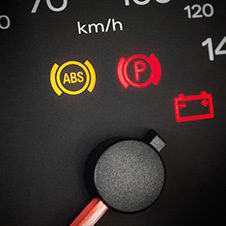
ABS Light on Dashboard
ABS warning light? We diagnose ABS faults & fix them fast. Stay safe on the road with certified ABS repairs. Book your check now.

Need help fixing this issue?
Find a trusted workshop for professional car service and diagnostics near you.
Find your nearest workshop or book a diagnostic appointment today.
Can you still drive your car?
If your ABS light is on, you can usually still drive the vehicle for a short time, but you should do so with caution and get it checked as soon as possible. The ABS (anti-lock braking system) helps prevent wheel lock-up during hard braking, especially on wet or slippery roads. When the light is on, your normal brakes still work, but the anti-lock safety function may not — meaning you could skid under emergency braking. Repair costs vary widely depending on the cause: a faulty wheel speed sensor is often the most common and typically the least expensive fix, while issues like a damaged ABS module or hydraulic unit can be significantly more costly. Minor repairs may be relatively affordable, but major component replacement can become expensive, so early diagnosis is the best way to avoid higher costs.
Seeing the ABS light on your dashboard can be alarming. Your car’s Anti-lock Braking System (ABS) is crucial for safe stopping—especially in slippery conditions. This article explains why the ABS light comes on, what it means, and how e‑CAR can help with fast, accurate repairs.
5 Common Reasons why your ABS Light is on
1. Faulty Wheel Speed Sensor
Each wheel has a speed sensor that sends data to the ABS system. If a sensor is dirty or damaged, the system can’t detect wheel speed properly—triggering the light.
2. Low Brake Fluid Levels
The ABS system relies on sufficient brake fluid to function. If levels drop too low (due to a leak or wear), it could trigger the ABS light.
3. Malfunctioning ABS Control Module
The ABS module interprets sensor data and controls braking pressure. If it fails or loses communication with your car’s computer, the light will turn on.
4. Blown Fuse or Wiring Fault
Like many electronic systems, ABS is powered by fuses and wiring. A short circuit, blown fuse, or corroded connector can interrupt function.
5. Hydraulic Pump or Valve Failure
ABS pumps and valves control brake fluid pressure to prevent skidding. When these components fail, the system becomes inactive and triggers the warning.
What is the Cost to fix faulty ABS?
Here’s a realistic idea of what the typical costs look like when you’re dealing with an ABS wheel speed sensor versus an ABS control module, based on published repair estimates and some South African examples.
🚗 ABS Wheel Speed Sensor
A faulty wheel speed sensor — the part that detects wheel rotation and feeds data to your ABS system — is one of the most common causes of the ABS light coming on.
Typical total replacement cost (parts + labour) for one sensor usually sits in the lower range because it’s fairly simple to access and replace.
In South Africa, some reported estimates for sensor replacement on a typical hatch (e.g., Polo) are around R1,800–R2,000 for the job.
If you go by parts alone, many wheel speed sensors online are sold around R800–R1,700 depending on vehicle make and model.
So a reasonable ballpark for a faulty sensor in SA:
👉 R1,500–R3,000 per wheel — depending on car, whether aftermarket or OEM part, and labour rates.
🔧 ABS Control Module (ECU / Electronic Unit)
The ABS control module is much more complex — it’s the computer that manages the anti‑lock brake system.
If it’s just a repair (electronics / board level), South African specialists sometimes quote anywhere from R2,000 up to R15,000 — the wide range reflects complexity and vehicle type.
A full module replacement job usually costs significantly more. Global estimates suggest the total installed cost including programming often falls in the range of $450–$1,300+ (which translates roughly to R8,000–R25,000+ depending on exchange rate, vehicle complexity, and dealer vs independent shop).
A local MechanicBuddy quote for an older Fiesta control module saw figures around R650–R895 — but that’s for a smaller/older unit and doesn’t include programming.
So for the ABS control module in South Africa:
👉 R8,000–R25,000+ installed is a realistic expectation for most cars — considerably higher than a simple sensor fix.
🛠 Key Differences in Cost
Speed sensor replacement is relatively cheap and often resolves the ABS light issue.
ABS control module repairs can be expensive because they often require diagnostics, recalibration/programming, and sometimes specialised tools.
What is ABS?
ABS stands for Anti-lock Braking System
The anti-lock braking system helps the tyres on your vehicle maintain contact with the road while you are braking. It functions by preventing the wheels from locking up, which can result in uncontrollable skids. The main purpose of the Anti-lock Braking System is to improve vehicle control under heavy braking, especially on loose, wet, or slick surfaces. It does not necessarily decrease stopping distance, although it can help.
Here are some things you need to know about ABS safety:
- The ABS system does a self-test every time you turn on the ignition. Once you start your vehicle, the light will briefly come on, and if the computer finds a problem, the light will stay on. If you notice the light flash immediately after starting the vehicle, that is just your vehicle doing a self-check.
- If the warning light comes on while you are driving, it means the ABS is not working properly. Your brakes will still work, but the ABS might not engage if you need to make an emergency stop. If the light remains on, you need to have a mechanic diagnose the ABS light issue as soon as possible. Since the ABS helps with vehicle control and stopping distances, it is an important safety feature to maintain – you never know when you’ll need it.
- If both the ABS and brake system light (your handbrake light on the instrument cluster) come on at the same time, your vehicle is no longer safe to drive. This means there is a serious problem with the braking system, and continuing to drive puts yourself and others at risk of a car crash.
- As you are braking heavily and your Anti-lock Braking System engages, you will notice the brake pedal pulsating. This is completely normal and it means the ABS system is working normally. The Anti-lock Braking System works with your braking system to create this pulsating so the wheels do not lock up. Once you feel this pulsating, keep your foot on the brake pedal and let the ABS system do the work for you. All you need to do is concentrate on steering safely. In basic terms, the braking system is applying the brake and in a split second releasing pressure and then reapplying the pressure to prevent the tyres from skidding or locking up on the surface. This happens multiple times a second.
Driving with the ABS Light on is not a good idea because it means your Anti-lock Braking System is not working properly. This means your vehicle may not handle like it is designed to under heavy braking. If both your Anti-lock Braking System Light and brake system light come on, this is an emergency and you need to stop driving right away. Have your entire brake system inspected by a certified mechanic, such as one from e-CAR.
ABS Light On? Book ABS Diagnostics & Repairs | e-CAR
ABS warning light? We diagnose ABS faults & fix them fast. Stay safe on the road with certified ABS repairs. Book your check now.
find a workshop near you
e-CAR Services
Car servicing
Routine, minor and major services to keep your vehicle properly maintained.
Car repairs
Full list of repair services
Aircon Regas
Restore your vehicle’s cooling performance with a professional aircon inspection and regas.
Mechanical Repairs
Professional repairs for worn, damaged or faulty mechanical components.
Brake Repairs
Inspection, maintenance and repair of brake pads, discs, fluid and related braking components.
Engine & Cooling
Diagnosis and repair of engine, radiator, water-pump, overheating and cooling-system problems.
Suspension Repairs
Repairs to shocks, wheel bearings, CV joints, and other suspension parts.
Transmission and Clutch Repairs
Diagnosis and repair of clutch, gearbox, transmission and drivetrain problems.
Diagnostics
Advanced diagnostic testing to identify warning lights, electronic faults, engine problems and performance issues.
Commercial-Vehicle Services
Servicing, maintenance and mechanical repairs for bakkies, LDVs and selected commercial vehicles.
Fleet Maintenance
Service a fleet of cars or trucks with a fast turnaround time.
e‑CAR workshops provide a broad range of servicing, maintenance, diagnostic and mechanical repair solutions. Services and vehicle capabilities vary by workshop, so check your local workshop’s profile before booking.
e-CAR Services
Car service
Car repairs
Full list of repair services
Aircon Regas
Restore your vehicle’s cooling performance with a professional aircon inspection and regas.
Mechanical Repairs
Professional repairs for worn, damaged or faulty mechanical components.
Brake Repairs
Inspection, maintenance and repair of brake pads, discs, fluid and related braking components.
Engine Cooling
Diagnosis and repair of engine, radiator, water-pump, overheating and cooling-system problems.
Suspension Repairs
Repairs to shocks, wheel bearings, CV joints, and other suspension parts.
Transmission & Clutch Repairs
Diagnosis and repair of clutch, gearbox, transmission and drivetrain problems.
Diagnostics
Advanced diagnostic testing to identify warning lights, electronic faults, engine problems and performance issues.
Commercial-Vehicle Services
Servicing, maintenance and mechanical repairs for bakkies, LDVs and selected commercial vehicles.
Fleet Maintenance
Service a fleet of cars or trucks with a fast turnaround time.
e‑CAR workshops provide a broad range of servicing, maintenance, diagnostic and mechanical repair solutions. Services and vehicle capabilities vary by workshop, so check your local workshop’s profile before booking.
Approvals & accreditations
Trust
e-CAR is accredited with RMI, MIWA approvals, and Right 2 Repair Supporter in SA for top-quality vehicle servicing and workmanship that meets industry standards.